

NCHRP Project 20-123(16A): Roadmap for the Transformation to Computer Simulation-Based Assessment of Bridge Railings
The objectives of this study are to (1) evaluate the capability of existing numerical simulations tools in capturing the performance of bridge rails and rail transition systems and (2) develop a roadmap to implement using computer simulations for the compliance assessment of bridge rails and rail transition systems.
NCHRP Project 22-50: Crashworthiness of Roadside Hardware on Curbed Roadways
The objectives of this project are 1) to determine the effects of curbs on the crashworthiness of selected roadside safety hardware at various speeds, geometries, and offsets from the curb, 2) to develop guidelines for the use of roadside safety hardware in combination with curb, 3) to prepare the guidelines for incorporation into a future update of the AASHTO Roadside Design Guide, and 4) provide recommendations for any additional crash testing requirements that should be made to MASH on roadside safety hardware installed in combination with curb.
MASH Evaluation Training Development for the National Highway Institute
The objective of this project is to develop a course to help participants 1) perform evaluations using MASH guidelines and crash test data and 2) interpret crash test results to determine whether or not the hardware meets MASH performance criteria.

MASH Evaluation of MaineDOT’s Approach Guardrail Transition Designs using Finite Element Analysis
The objective of this project is to evaluate the crash performance of three MEDOT Approach Guardrail Transition (AGT) designs under MASH TL-3 impact conditions and performance criteria using finite element analysis. The subject designs include:
1) 3-bar concrete transition barrier with a transition curb.
2) 4-bar concrete transition barrier with a taper added to the nose on sidewalk (modified design).
3) 4-bar steel transition on sidewalk.
A Safe System Approach Framework to Roadway Departure in the U.S.
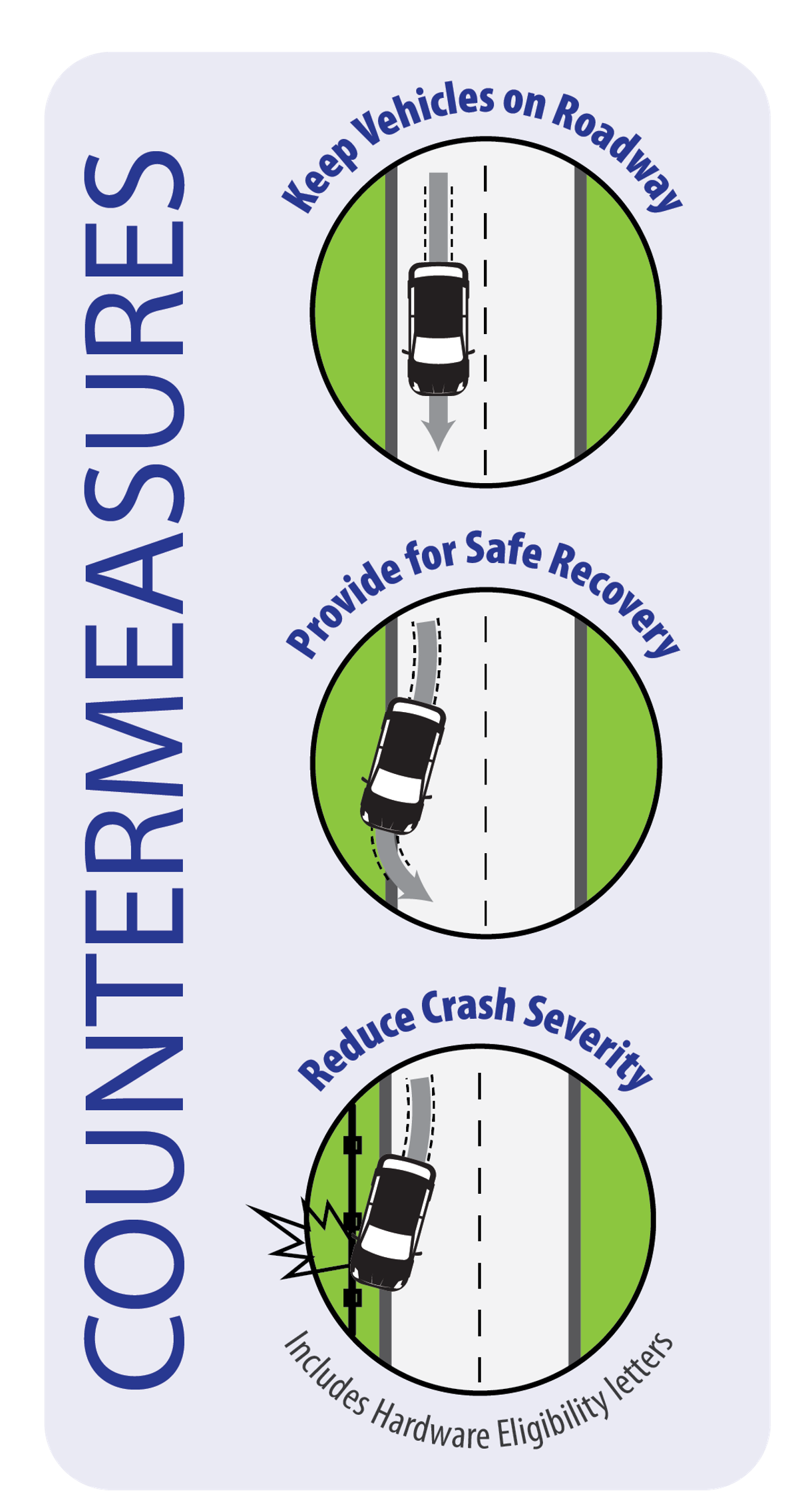
The objective of this project is to develop a technical basis by which practitioners apply Safe System methodology to inform planning and design decisions to minimize roadway departure fatalities and serious injuries.
MASH TL3 Evaluation of MassDOT’s Revised CM-MTL3 Bridge Rail Design using Finite Element Analysis
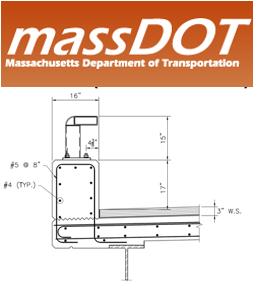
The crash performance of the revised MassDOT CM-MTL3 combination concrete barrier with steel top rail was evaluated for the Massachusetts Department of Transportation (MassDOT). The evaluation was performed using finite element analysis (FEA) using impact conditions and evaluation procedures set forth in the AASHTO Manual for Assessing Safety Hardware (MASH) for Test Level 3 (TL3). Two critical impact cases were evaluated for Test 3-10 and Test 3-11: (1) Splice Reference Case – critical impact point for maximizing potential for snag on the rail expansion splice, and (2) Post Reference Case – critical impact point for maximizing loading and potential snag on the critical bridge rail post located immediately downstream of the rail splice and expansion joint. Based on the results of all analysis cases, the CM-MTL3 with the proposed design revisions is expected to meet all performance criteria specified in MASH for test level 3. The results of this research were documented in Technical Report TR 23-0207-GEA-CMMTL3, which is available here: MASH TL3 Evaluation of MassDOT’s Revised CM-MTL3 Bridge Rail Design using Finite Element Analysis
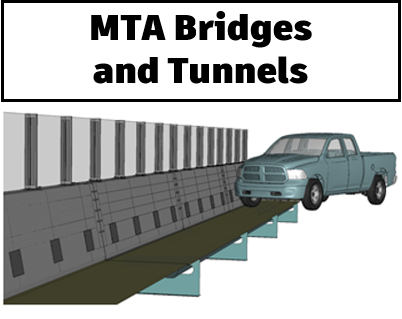
MASH TL4 Evaluation of a Proposed Median Barrier and Windscreen Design for the TBTA Robert F. Kennedy Project – Phase I
This report evaluates the crash performance of a proposed 42-inch single-slope modular steel shell median barrier with 36-inch acrylic windscreen panels for the Triborough Bridge and Tunnel Authority's RK-19/RK-70 Wind Retrofits project. Finite element analysis (FEA) using LS-DYNA software assessed the barrier design under AASHTO Manual for Assessing Safety Hardware (MASH) Test Level 4 criteria, including Tests 4-10 (small car), 4-11 (pickup truck), and 4-12 (single-unit truck). Detailed FEA models incorporated the barrier structure, windscreen assembly, bridge deck, and representative substructure connections. Results demonstrated the barrier successfully contained and redirected all test vehicles with minimal structural damage. Occupant risk measures, including occupant impact velocity (OIV) and occupant ridedown acceleration (ORA), remained within MASH preferred limits. The single-unit truck analysis revealed potential windscreen post deformation when cargo-bed heights exceeded 50 inches, though structural integrity was maintained. Based on comprehensive evaluation of structural adequacy, occupant risk factors, and vehicle stability, the proposed median barrier design is expected to meet all MASH Test Level 4 performance criteria.
MASH TL3 Evaluation of MassDOT’s CM-MTL3 Bridge Rail Using Finite Element Analysis
The crash performance of the MassDOT CM-MTL3 combination concrete barrier with steel top rail was evaluated for the Massachusetts Department of Transportation (MassDOT). The evaluation was performed using finite element analysis (FEA) using impact conditions and evaluation procedures set forth in the AASHTO Manual for Assessing Safety Hardware (MASH) for Test Level 3 (TL3). Two design options for the bridge rail were evaluated: 1) Integral safety-curb design, 2) Vertical face on concrete. Both designs were found to meet MASH performance criteria for TL3. The vertical face design is recommended for future installations. The results of this research were documented in Technical Report TR 21-0730-GEA, which is available here: MASH TL3 Evaluation of MassDOT’s CM-MTL3 Bridge Rail Using Finite Element Analysis
NCHRP Project 22-44: Transportation Agency Data Collection Practice for Use with In-Service Performance Evaluations (ISPEs)
The objective of this project is to develop guidance for the collection, extraction, and documentation of In-Service Performance Evaluation (ISPE) data to compliment the analysis procedures developed under NCHRP 22-33. The results of this research were published as NCHRP web only document 407 in 2024, which is available here: Data Collection Practices for Use with In-Service Performance Evaluations

MASH TL2 Evaluation of MassDOT’s BR-MTL2 Bridge Rail Using Finite Element Analysis
The crash performance of the MassDOT BR-MTL2 combination concrete parapet with steel top rail was evaluated for the Massachusetts Department of Transportation (MassDOT). The evaluation was performed using finite element analysis (FEA) using impact conditions and evaluation procedures set forth in the AASHTO Manual for Assessing Safety Hardware (MASH) for Test Level 2 (TL2). Two design cases were evaluated including the baseline design and a revised design. The revised design included an anchor plate at the post mounting locations and additional longitudinal steel reinforcing in the parapet. These modifications provided greater strength for the anchors and reduced the severity of damage to the concrete parapet. Based on the results of all analysis cases, both the baseline and revised designs are expected to meet all performance criteria specified in MASH for test level 2. The results of this research were documented in Technical Report TR 23-0509-GEA-BRMTL2, which is available here: MASH TL2 Evaluation of MassDOT’s BR-MTL2 Bridge Rail Using Finite Element Analysis

MASH TL3 Evaluation of MassDOT’s CP-MTL3 Bridge Rail Using Finite Element Analysis
The crash performance of the MassDOT CP-MTL3 combination concrete parapet with aluminum handrail was evaluated for the Massachusetts Department of Transportation (MassDOT). The evaluation was performed using finite element analysis (FEA) using impact conditions and evaluation procedures set forth in the AASHTO Manual for Assessing Safety Hardware (MASH) for Test Level 3 (TL3). Two critical regions of the system were evaluated. The first critical region was the expansion joint of the bridge and parapet. The second critical region was at the approach to the concrete transition at the downstream end of the system. The results of the finite element analyses indicated that the CP-MTL3 bridge rail met all performance criteria specified in MASH for test level 3. The results of this research were documented in Technical Report TR 21-0121-GEA, which is available here: MASH TL3 Evaluation of MassDOT’s CP-MTL3 Bridge Rail Using Finite Element Analysis

MASH TL2 Evaluation of MASSDOT's Curb-Mounted and Sidewalk-Mounted CT-MTL2 Bridge Rail Using Finite Element Analysis
The crash performance of the MassDOT CT-MTL2 aesthetic concrete barrier was evaluated for the Massachusetts Department of Transportation (MassDOT). The evaluation was performed using finite element analysis (FEA) using impact conditions and evaluation procedures set forth in the AASHTO Manual for Assessing Safety Hardware (MASH) for Test Level 2 (TL2). Three design options for the bridge rail were evaluated: 1) Integral safety-curb design, 2) Sidewalk-mounted option in which the bridge rail without an integral safety-curb was mounted onto the top of a sidewalk with an 8-inch curb and 3) Sidewalk-mounted option in which the bridge rail with the integral safety-curb was mounted onto the top of a sidewalk with an 8-inch curb face. The results of this research were documented in Technical Report TR 21-0121-GEA, which is available here: MASH TL2 Evaluation of MASSDOT's Curb-Mounted and Sidewalk-Mounted CT-MTL2 Bridge Rail Using Finite Element Analysis
NCHRP Project 22-40 Continuation: Investigation of Material Requirements for Highway High Tension Cable Barriers Specifications
The objective of this project is to develop an acceptance plan that can be used as guidance by the states when they are developing their standard specifications, standard details, and special provisions for High Tension Cable Barrier (HTCB) projects. This document will help to ensure conformance with the state-of-practice for HTCB systems and improve uniformity of HTCB installations among states. This is continuation of NCHRP 22-40 which was an update to AASHTO M 180 "Standard Specification for Corrugated Sheet Steel Beams for Highway Guardrail". The final report can be found here: Investigation of Material Requirements for Highway High Tension Cable Barriers Specifications NCHRP 22-40 Continuation
NCHRP Project 22-40: Update to AASHTO M 180-18 and Associated Highway Guardrail Specifications
The objectives of this project were to 1) perform a comprehensive review of AASHTO M 180-18 and its associated AASHTO and ASTM standards and 2) propose needed revisions to bring the specifications into conformance with current requirements and the state of practice for highway guardrail systems. AASHTO M 180 is the AASHTO "Standard Specification for Corrugated Sheet Steel Beams for Highway Guardrail". AASHTO M 180 defines the strength and geometrical properties of generic (i.e. non-proprietary) w- and thrie-beam guardrail as well as transitions and some associated connectors and parts. AASHTO M 180 has been the industry standard for those components since 1961. The results of this research were published as NCHRP Research Report 1020 in 2022, which is available here: Investigation of Material Requirements for Highway Guardrail Systems
NCHRP Project 22-33: Multi-State In-Service Performance Evaluations of Roadside Safety Hardware
This project developed a unified and nationally compatible ISPE methodology. The approach builds on recent research and capitalizes on the variety of individual state databases available. Six pilot Transportation Agencies tested the methodology by using it to perform assessments using their own already-collected data. The results of this research were published as NCHRP Research Report 1010 in 2022, which is available here: In-Service Performance Evaluation: Guidelines for the Assembly and Analysis of Data
NCHRP Project 20-07(401): Roadside Hardware Replacement Analysis User’s Guide
The report, accompanying training slides, and Excel workbook present a systematic methodology for assessing when existing roadside hardware should be considered for replacement with hardware tested to the 2016 Manual for Assessing Safety Hardware (MASH). In particular, the report looks at one of the most common systems, 27-3/4" tall strong-post w-beam guardrail and evaluates conditions where replacing it with 31" tall strong-post w-beam guardrail is appropriate. The results of this research were published as NCHRP Web-Only Document 292 in 2021, which is available here: Roadside Hardware Replacement Analysis: User Guide
NCHRP Project 15-65: Development of Safety Performance Based Guidelines for the Roadside Design Guide
This project continued the theoretical development of the modelling methods used in RSAPv3. More robust and accurate methods for assessing and predicting crashes were developed taking advantage of some recent research. A quantifiable systematic methodology was developed for assessing and evaluating the effectiveness of roadside designs that can be used to update future editions of the Roadside Design Guide. The results of this research were published as NCHRP Research Report 972 in 2022, which is available here: Development of Safety Performance-Based Guidelines for the Roadside Design Guide
NCHRP Project 22-31: Selection and Placement Guidelines for Test Levels 2 through 5 Median Barriers
This project developed risk-based guidelines for determining when and what type of median barrier is necessary based on the traffic and highway characteristics at a particular site. This project was extended to include the development of guidelines for the use of roadside barrier to shield fixed objects. The results of this research were published as NCHRP Report 996 in 2022, which is available here: Selection and Placement Guidelines for Test Level 2 Through Test Level 5 Median Barriers

NCHRP Project 22-32: Development of Methods to Evaluate Side Impacts for Next Edition MASH
The objective of this project is to develop recommended test and evaluation procedures for side impact crash testing that can be considered for inclusion in a future update of the Manual for Assessing Safety Hardware (MASH).
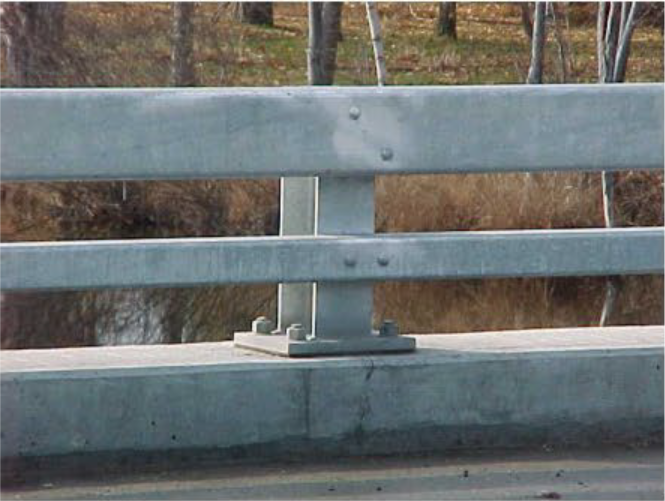
NETC 20-1 In-Service Performance Evaluation of NETC Bridge Railings
The research objective of this project was to determine the in-service performance of the NETC bridge railings and transition systems based on the percentage of fatal and serious injury crashes and barrier penetrations. MaineDOT is using these results to provide evidence that NETC rail performs well. MaineDOT changed their standard details to formally adopt MASH without crash testing because this study and the previous FEA modeling study show good performance.
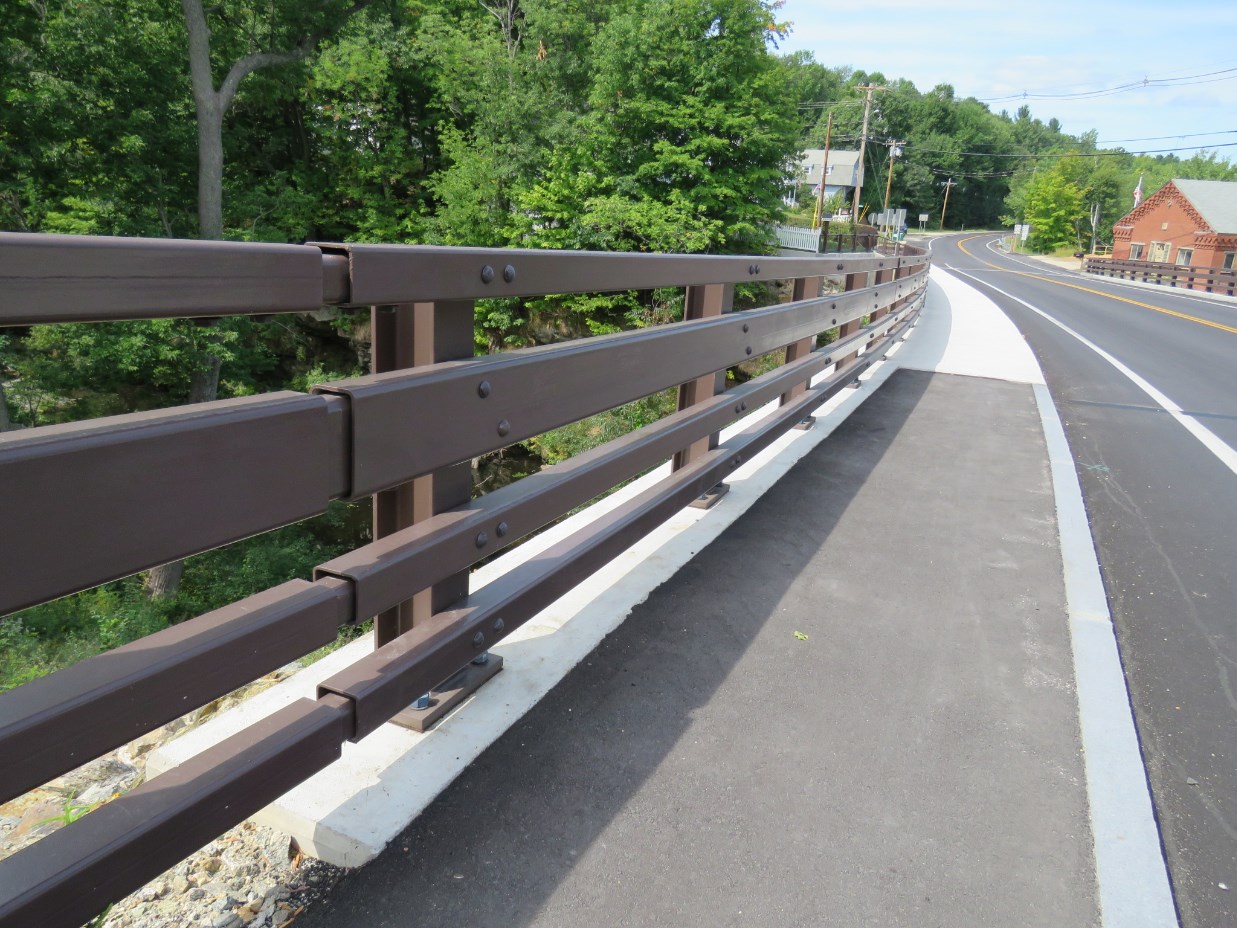
Development of MASH Computer Simulated Steel Bridge Rail and Transition Details and In-Service Performance Evaluation of NETC Bridge Railings
The predominant bridge railing used in the New England States are two-, three-, and four-bar steel post-and-beam designs and are commonly referred to as NETC bridge railings. They were originally tested under AASHTO and NCHRP standards and have been in service for over 20 years. In accordance with the Joint Agreement between AASHTO and FHWA, a project was recently completed to evaluate the crash performance of the NETC bridge rail systems under the MASH criteria using finite element analysis. The study concluded that the existing NETC bridge railing designs would meet the new crash testing standards but also recommended minor design modifications to further improve performance. The NETC bridge railings were further evaluated using the procedures provided in the recently published NCHRP Report 1010, “Multi-State In-Service Performance Evaluations (ISPE) of Roadside Safety Hardware”.
MASH TL3 Evaluation of the Concrete Reaction Tension System (CRTS) Quickchange Moveable Barrier (QMB) Barrier
The objectives of this study were to define the critical minimum length of the system to achieve minimum barrier deflection when the system is impacted at its midpoint under MASH Test 3-11 conditions (i.e., 5,000-lb pickup impacting at 60 mph and 25 degrees); and to then evaluate the crash performance of this critical-length system at impact locations approaching both the leading and trailing ends of the system for MASH Test 3-11 conditions. This system has been successfully full-scale crash tested to MASH Test Level 3 at the Texas Transportation Institute.

MASH TL4 Evaluation of MASS DOT's Curb-Mounted and Sidewalk-Mounted S3-TL4 Steel Bridge Railing Using Finite Element Analysis
The objective of this project was to evaluate the crash performance of the MassDOT S3-TL4 bridge rail design using FEA. The impact conditions and assessment procedures conformed to the specifications in MASH for TL-4, which included evaluations of structural capacity, risk of occupant injury and vehicle stability during impact and redirection. Two design options for the bridge rail were evaluated: 1) a curb-mounted option in which the bridge rail was mounted onto the top of an 8-inch reinforced curb that is integral to the bridge deck, and 2) a sidewalk-mounted option in which the bridge rail was mounted onto the top of a 5-ft wide sidewalk with an 8-inch curb face. The final report can be found here: MASH TL4 Evaluation of MASS DOT's Curb-Mounted and Sidewalk-Mounted S3-TL4 Steel Bridge Railing Using Finite Element Analysis
MASH TL4 Evaluation of MASS DOT's Curb-Mounted and Sidewalk-Mounted Highway Guardrail Approach Transition Using Finite Element Analysis
The purpose of this project was to evaluate the crash performance of an existing approach guardrail transition design for the Massachusetts Department of Transportation using finite element analysis. The final report can be found here: MASH TL4 Evaluation of MASS DOT's Curb-Mounted and Sidewalk-Mounted Highway Guardrail Approach Transition Using Finite Element Analysis
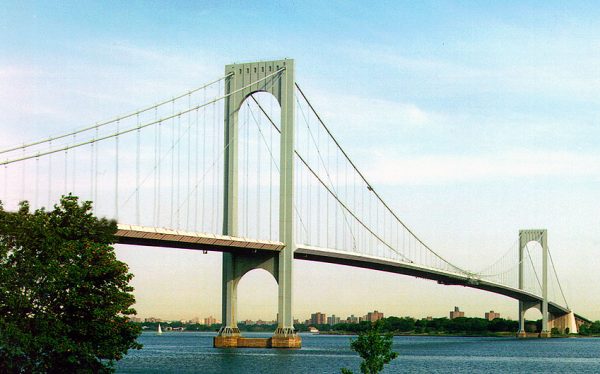
MASH TL4 Evaluation of the Proposed Median Barrier Extension at the Bronx-Whitestone Bridge
The purpose of this project was to evaluate the crash performance of the proposed median barrier extension for the existing median barrier at the Bronx-Whitestone Bridge using evaluation procedures set forth in MASH for test level 4. This system has been successfully full-scale crash tested to MASH Test Level 4 at the Texas Transportation Institute.

MASH TL5 Evaluation of the Proposed Three-Rail Barrier
NYSTA required a MASH Test Level 5 (TL5) bridge rail. Since no existing TL5 bridge rail designs were available that met the requirements for the given application, an existing TL4 design was adopted and then modified to increase its strength capacity to achieve Test Level 5 performance. This system has been successfully full-scale crash tested to MASH Test Level 5 at the Texas Transportation Institute.
Evaluation of Proposed Design Modification to Oregon 3-Tube Bridge Rail
The objectives of this project were to evaluate a proposed design modification for strengthening the Oregon 3-tube bridge rail and verify that the design change meets the FHWA criteria for "inconsequential / positive" change based on NCHRP Report 350 Test Level 4 performance conditions.

Evaluation and Design of a TL-3 Bridge Guardrail System Mounted to Steel Fascia Beams (2015-ORIL1)
The objective of this research project is the development of a cost-effective TL-3 post-and-beam type bridge rail system designed for mounting to the steel fascia beam of Ohio rural bridges.
NCHRP Project 12-90: Guidelines for Shielding Bridge Piers
This project developed risk-based guidelines that quantify when bridge piers should be investigated for vehicular collision forces or be shielded with a longitudinal barrier. The results of this research were published as NCHRP Research Report 892 in 2018, which is available here: Guidelines for Shielding Bridge Piers
NCHRP Project 17-54: Consideration of Roadside Features in the Highway Safety Manual
The objective of this project was to develop quantitative assessment measures that can be incorporated into the AASHTO Highway Safety Manual to evaluate the effects of roadside designs and features on the frequency and severity of lane departure crashes. Using the largest databases of State crash data available allowed for the development of two-lane undivided and four-lane divided highway models. Statistical adjustments for road features like curvature, grade, number of lanes, speed limit and many other conditions were modelled. The result was a model that predicts the frequency of fatal and serious injury crashes based on traffic conditions and highway characteristics. The results of this research were published in 2022 as NCHRP Web-Only Document 325 which is available here: Consideration of Roadside Features in the Highway Safety Manual
NCHRP Project 22-28: Criteria for Restoration of Longitudinal Barriers -- Phase II
The objective of this project was to develop a field guide to assist highway agencies in deciding when guardrails need to be repaired based on the observed damage. The results of this research were published in 2021 as NCHRP Web-Only Document 304 in 2021 which is available here: Criteria for Restoration of Longitudinal Barriers, Phase II
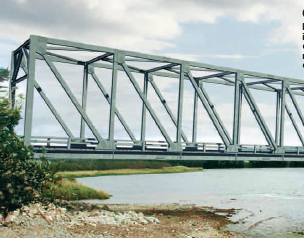
Modified NETC 4-Bar Bridge Rail for Steel Through-Truss Bridges
The objective of this project was to develop a modified design of the NETC 4-Bar bridge rail to accommodate installation on steel through-truss bridges. This bridge rail was previously tested to Report 350 TL4 conditions, and the goal of the project was to achieve Report 350 TL-4 eligibility for the modified design in accordance with the (then current) FHWA eligibility requirements. The evaluations were performed using FEA. The final design modifications were determined to meet all structural capacity, occupant risk measures and vehicle stability criteria set forth in NCHRP Report 350.

NCHRP Project 20-7(360): Development Of A Strategic Plan For TCRS
The objective of this research is to develop a strategic plan for TCRS that guides the technical committee activities in its role as the focal point for roadside safety policies and guidance.
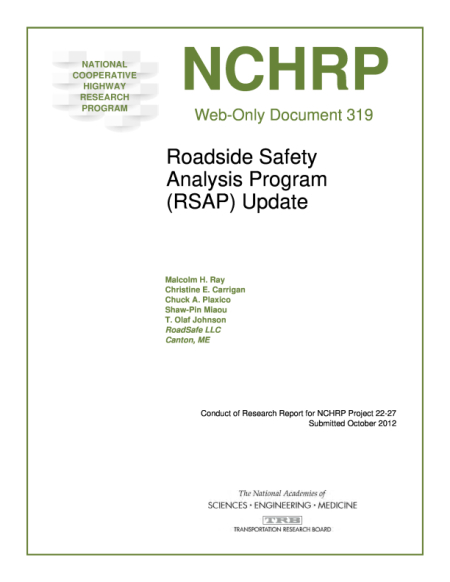
NCHRP Project 22-27: Roadside Safety Analysis Program Update
The purpose of this project was to update and re-code the RSAP program used for roadside safety benefit-cost analysis. The methods and coding for the program were completely redone to take advantage of advances in statistical analysis methods and improved understanding of roadside crashes. RSAPv3 is used to evaluate roadside design based on either a benefit-cost approach or a risk of serious or fatal crash approach. RSAPv3 has been used and extended in many of Roadsafe LLC’s subsequent projects. The results of this research were published in 2022 as NCHRP Web-Only Document 319 which is available here: Roadside Safety Analysis Program (RSAP) Update
Update to A Guide to Standardized Highway Lighting Pole Hardware
The purpose of this project was to update the content of the AASHTO-ARTBA-AGC Task Force 13 Luminaire Guide and to put the guide on-line as a searchable database of crash tested luminaire designs.
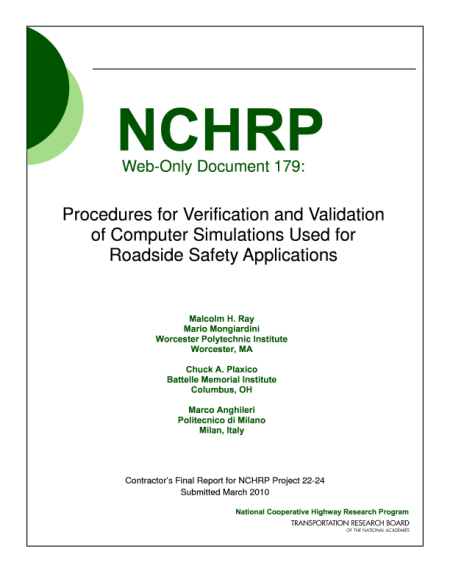
NCHRP Project 22-24: Recommended Procedures for Verification and Validation of Computer Simulations used for Roadside Safety Applications
A computer program was developed that compares the data collected in a crash test to the results of a finite element analysis. Quantitative measures were developed to rank the result allowing engineers to determine how much confidence they can have in their computer simulations. The results of this research were published in 2011 as NCHRP Web Document 179, which is available here: Procedures for Verification and Validation of Computer Simulations Used for Roadside Safety Applications
Download the Roadside Safety Verification and Validation Program (RSVVP)
RSVVP 32 bit
RSVVP 64 bit
Evaluation of the Existing Guardrail on the TRC Test Track
The objective of this project is to examine the likely performance of the guardrail installed on the TRC test track in the 1970’s and determine if it is adequate for future anticipated use.
NCHRP Project 22-12(03): Recommended Guidelines for the Selection of Test Levels 2 through 5 Bridge Railings
This project developed risk-based guidelines for the selection of Test Levels 2 through 5 bridge rails considering in-service performance, benefit-cost analysis, and risk assessment. The results of this research were published as NCHRP Web-Only Document 307 which is available here: Recommended Guidelines for the Selection of Test Levels 2 Through 5 Bridge Railings
NCHRP Report 490: In-Service Performance of Traffic Barriers
Twenty years ago, some of the current Roadsafe LLC staff developed NCHRP Report 490, “In-Service Performance of Traffic Barriers.” This document was the first comprehensive guide for performing in-service performance evaluations (ISPE). The guide includes a description of an ISPE methodology, a field guide, and the results of five ISPEs performed to demonstrate the techniques outlined in the guide.


Roadsafe LLC